

how to clean a ge profile ro drain line>
Written by: Gene Fitzgerald // Last Updated:
Please note: This page may contain affiliate links. If you buy a product or service through such a link we earn a commission at no additional cost to you. Learn more about our product review process or check our FTC affiliate disclosure.
Reverse osmosis systems usually last for years without causing trouble.
But even if yours doesn't, the good news is that most problems are really simple to diagnose and repair, especially with the help of our RO Troubleshooting Guide below.
With it you hopefully have the right tool at hand to face and solve just about any issue without the need to call a professional and spend any money.
Contents
- Reverse osmosis troubleshooting & repair guide – overview
- System drains constantly (drain line keeps running)
- RO storage tank not filling up
- Leaking system
- Slow/no water flow from faucet & low pressure
- Water tastes bad
- Noisy air gap faucet or drain
RO Troubleshooting & Repair Guide – Overview
This table lists common RO system problems + potential causes and their solutions. Click on the highlighted names in the left column to jump to according page sections.
(Mobile Hint: Swipe to Scroll)
| Problems | Possible Causes | Solutions |
|---|---|---|
| System drains constantly (drain line keeps running) | Storage tank pressure too low | Measure + repressurize |
| Damaged tank air bladder | Replace tank | |
| Broken shut-off valve | Test + replace | |
| Broken check valve | Test + replace | |
| Feed water pressure below 40 psi | Increase pressure in your home or install a booster/permeate pump | |
| System installed improperly | Re-check the whole system | |
| Reverse osmosis membrane in bad condition | Replace | |
| Worn-out flow restrictor | Replace | |
| RO storage tank not filling up | Storage tank pressure too high | Measure + release pressure |
| Feed water pressure below 40 psi | Increase pressure in your home or install a booster/permeate pump | |
| Reverse osmosis membrane in bad condition | Replace | |
| Clogged filter(s) | Replace | |
| RO membrane not properly seated | Readjust | |
| Bent tubing | Straighten all water lines | |
| Feed water valve closed | Open valve | |
| Water storage tank valve closed | Open tank valve | |
| Leaking system | Loose connection | Tighten |
| Damaged connection | Replace | |
| Leaky faucet | Loose connection | Tighten |
| Damaged faucet stem | Replace faucet | |
| Clogged drain line (air gap faucets only) | Unclog | |
| Shifted drain saddle (air gap faucets only) | Realign drain saddle with drain hole | |
| Leaking filter/membrane housing | Misplaced O-ring | Reposition |
| Worn-out O-ring | Replace | |
| Loose housing cap | Retighten | |
| Damaged housing | Replace | |
| Slow/no water flow from faucet & low pressure | Storage tank pressure too low | Measure + repressurize |
| Damaged tank air bladder | Replace tank | |
| Storage tank pressure too high | Measure + release pressure | |
| Feed water pressure below 40 psi | Increase pressure in your home or install a booster/permeate pump | |
| Reverse osmosis membrane in bad condition | Replace | |
| Clogged filter(s) | Replace | |
| RO membrane not properly seated | Readjust | |
| Clogged flow restrictor | Unclog or replace | |
| Bent tubing | Straighten all water lines | |
| Empty storage tank | Let storage tank refill and consider buying a pressure pump to increase flow rate | |
| Feed water valve closed | Open valve | |
| Water storage tank valve closed | Open tank valve | |
| Water tastes bad | Depleted filters or membrane | Replace + clean system periodically |
| Fouled membrane | Replace + clean system periodically | |
| Stagnant water | Flush entire system once or twice | |
| Noisy air gap faucet or drain | New system or recent filter replacement | Will subside over time |
| Bent tubing | Straighten all water lines | |
| Restriction in drain saddle or tubing | Unblock | |
| Connection with air gap | Check system and tighten loose connections | |
| Cloudy water | Trapped air in newly installed system or filters | Will subside over time |
| No water goes down the drain | Clogged flow restrictor | Clean or replace |
| Clogged drain line | Unclog |
System Drains Constantly (Drain Line Keeps Running)
The functioning of a reverse osmosis system is based on pressure. Simply put: Feed water flows into the unit, gets purified and is then stored in the storage tank for later use. When the storage tank is full it triggers an automatic shut-off (ASO) valve to close. The valve stops more water from entering the system. A second valve, the check valve, prevents reject water from running down the drain line.
If tank pressure is too low or the shut-off valve or check valve is broken, water might flow continuously down the drain. This means that your RO system not only wastes a lot of water, the noises can also become quite annoying after a while.
The solution:
First, use a pressure gauge to measure the pressure in the storage tank when empty. The tank should read about 6-8 psi. In case the pressure is too low you need to repressurize.
How to Drain & Repressurize an RO Tank
- Shut off the water supply to the system.
- Close the storage tank valve.
- Disconnect the tank from the system and take it outside. Open the tank valve. In the beginning, water will pour out quickly, but after some time the flow will decrease to a trickle.
- Since a lot of water is still inside the tank, you have to pump air into the pressure valve with the help of a bicycle pump or compressor. With each pump more water will pour out.
- Once the tank is empty, take a pressure gauge to measure the pressure inside. For most tanks you should aim for somewhere between 6 to 8 psi (optimal value might state on tank label). Very carefully repressurize if need be using the pump or compressor.
- Now you can reconnect the tank to your reverse osmosis system. Open the tank and feed water valve and allow the system to refill.
The problem reoccurred a couple of days later? This means that the bladder inside the tank is ruptured and cannot hold the air. All you can do is replace the whole tank.
Tank pressure is within the desired range? Then it's likely that either the shut-off valve or the check valve is defect and needs to be replaced.
Checking Valves: Test #1
Here is how you can test if both ASO and check valve are functioning correctly:
- Let the storage tank fill completely. You know when the tank is full by trying to lift it up.
- Draw 2 to 3 glasses of water from the RO faucet to reduce the pressure inside the storage tank. This will cause your system to start processing more water to refill.
- Close the tank valve to mimic a full tank.
- Wait for 5 minutes.
- Check if water stops flowing down the drain line by either listening closely or by pulling the drain line out of the drain saddle. If so, both valves are working just fine. If, however, water does continue to flow down the drain, either the automatic shut-off valve or the check valve is broken. In that case continue with test #2.
Checking Valves: Test #2
- Let the tank refill.
- This time keep the tank valve open and turn off the feed water valve.
- Check if water is flowing down the drain by either listening closely or by pulling the drain line out of the drain saddle. If so, the water is coming straight out of the storage tank which means that the check valve is broken and needs replacement. If no water is flowing the ASO valve is broken and has to be replaced.
Other Possible Causes
Other possible causes for a system to constantly drain are:
- Feed water pressure is too low (usually below 40 psi). Increase the water pressure to the required level, e.g. by applying a booster pump.
- Your system wasn't installed properly so that the membrane causes the problem. Carefully reconnect all pieces making sure that they are in their correct position. Need help with how to install a reverse osmosis system?
- The RO membrane is in bad condition. Replace it.
- A worn-out flow restrictor inside the drain line is causing the problem. Replace the restrictor.
No matter how hard you try, sometimes a unit is broken beyond repair. If you need a replacement, you can find reviews of the best RO systems here.
RO Storage Tank Not Filling Up
If a storage tank does not fill there is usually an underlying pressure issue. Either tank pressure is too high or feed water pressure too low.
An empty storage tank should read roughly 6 to 8 psi. You can measure this with a standard bicycle gauge for example. Reduce pressure if need be.
If the feed water pressure is less than 40 psi you need to either increase the pressure in your entire home or use a pump specifically designed for reverse osmosis systems.
That wasn't it? Also consider:
- Clogged filters or bad RO membrane – Clogging usually occurs when a membrane has to process exceptionally hard water. You have two options: You can either replace membranes more frequently which will add to the costs. Or you can install an additional pre-treatment system – think water softener – which will remove all hardness minerals from the water before it enters the filter system. If one or more clogged filters are causing the problem, again, replacement is necessary.
- RO Membrane not properly seated
- Bent tubing
- Feed water valve or tank valve closed
Leaking System
Most of the times it's easy to identify what's causing a reverse osmosis system to leak. Simply check every single connection in order to find the culprit.
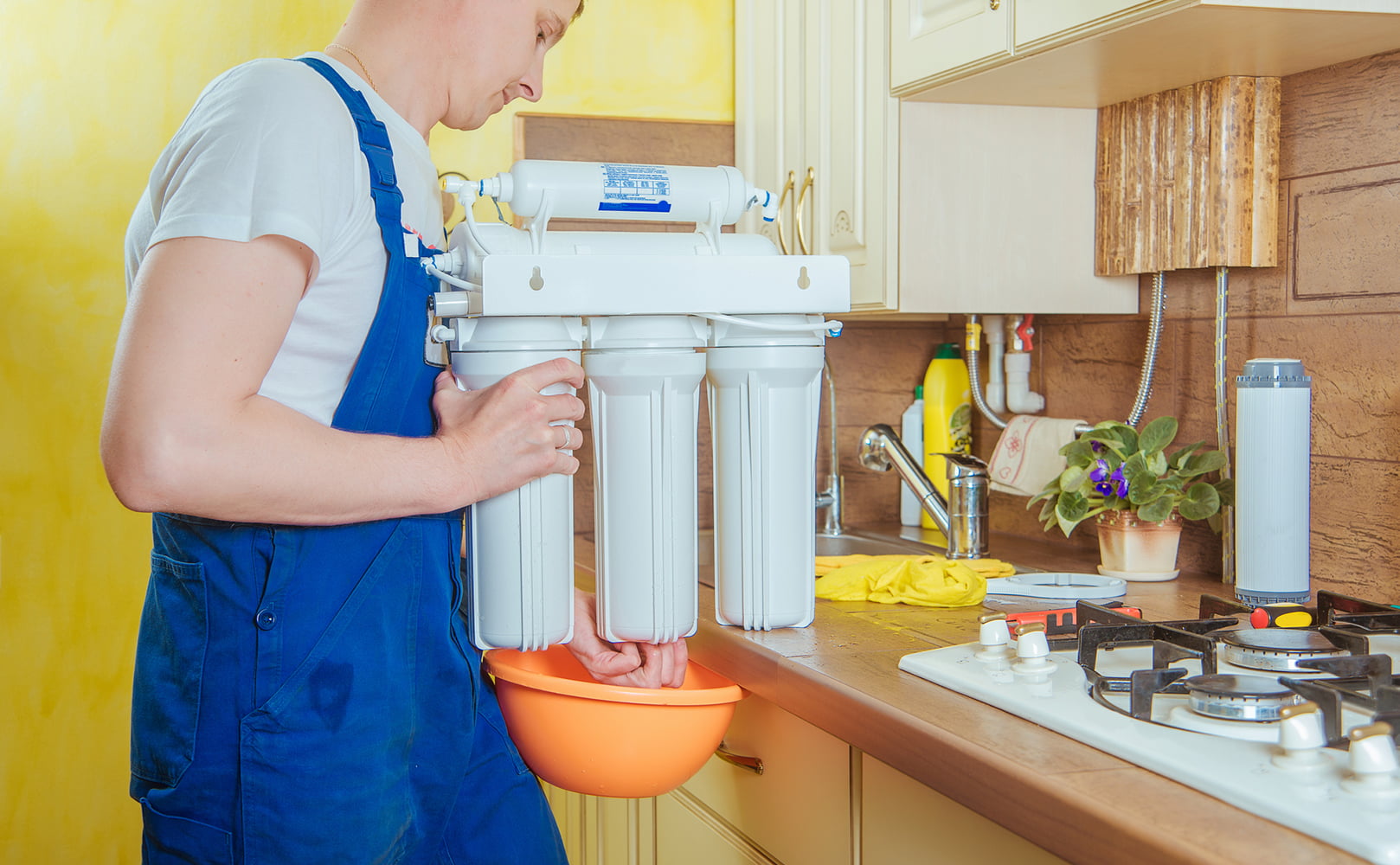
Leaky Faucet
A dripping faucet indicates that one or more system parts are loosely fitted. To stop the leaking, thoroughly tighten all connections. Push the tubing further into their ports, valves and the drain saddle.
If the leaking originates from the bottom of the faucet stem there is no way around replacing the piece.
Leaking Air Gap Faucet
Water is coming out of the hole of the air gap faucet above the sink? This commonly known issue is called an "air gap leak". It's the result of a blocked drain line which usually happens when debris has accumulated in the drain.
Now, the purpose of an air gap is to assure that water cannot flow backwards into the RO unit. During normal operation, water runs from the storage tank to the faucet and falls through a small pocket of air, the air gap.
When the drain line starts to clog up it creates backpressure which causes water to flow out of the gap and all over your countertop.
All you have to do to fix this is to clear off the drain line so water can flow freely. Take a pipe cleaner or wire brush to clean out the one end of the drain line that is connected to the drain saddle. Also clean the saddle itself, as stuff tends to grow in there.
What's more, drain saddles tend to shift so the holes aren't properly lined up anymore, which may also restrict the water flow. Make sure that drain saddle and drain line hole are aligned.
How to prevent an air gap leak in future?
Completely eliminating the chance of an occasional leak is almost impossible. However, you can take the necessary precautions to reduce their frequency quite significantly:
- First of all, avoid flushing large chunks of food and other stuff down the drain.
- Furthermore, regularly treat your drain line with natural cleaner to dissolve any blockades.
Leaking Filter/Membrane Housing
A misplaced or worn-out rubber O-ring is most likely responsible for causing a filter/membrane housing to leak. Here is what you should do:
- Close the feed valve so no more water can flow into the system.
- Close the storage tank valve.
- Unscrew the leaking filter housing.
- Inspect the O-ring(s). Replace if cracked or generally in a bad condition.
- Make sure that O-rings are placed correctly and sit tight.
- Screw the filter housing back on and hand tighten. Use the housing wrench to tighten an additional quarter turn or so.
- Open up the tank and feed water valve.
- If the filter housing is still leaking it may be damaged and needs replacement. You can check for this by switching it with one of the other housings.
It's also quite common for the membrane housing cap to come loose over time which displaces the O-ring. Periodical retightening is an easy fix.
Slow/No Water Flow From Faucet & Low Pressure
You had your reverse osmosis system for a number of years and like every other morning you are about to enjoy a refreshing glass of purified drinking water. For some reason, however, the glass only fills half full and the water flow goes down to a trickle.
Little or no flow from the faucet means that you either have low volume of water or low pressure.
The root of the problem is most likely a malfunctioning storage tank. Inside the tank is an air bladder that, as more water runs into the tank, increases pressure. If the bladder leaks it cannot build up enough force. As a result, you are not getting water delivered to your faucet in the same amount you are used to.
What can you do about this?
First, lift the tank to see if it's full. A full tank weighs somewhere around 28 lbs as opposed to an empty one weighing almost nothing. If the tank feels heavy the defect is probably in its inside.
Next, you want to measure the pressure of the tank when empty. An empty tank should read somewhere between 6 to 8 psi. If the pressure in your tank is lower then you need to repressurize it (learn more above).
The problem reoccurred a couple of days later? This means that the bladder inside the tank is ruptured and you need to replace the whole tank.
Other Possible Causes
Slow faucet water flow can also be an indicator for overall low feed water pressure (below 40 psi). A booster or permeate pump is your best option here. Other reasons that could be causing the issue are:
- Clogged filters or bad RO membrane – Clogging usually occurs when a membrane has to process exceptionally hard water. You have two options: You can either replace membranes more frequently which will add to the costs. Or you can install an additional pre-treatment system – think water softener – which will remove all hardness minerals from the water before it enters the filter system. If one or more clogged filters are causing the drop in flow, again, replacement is necessary.
- RO Membrane not properly seated
- Clogged flow restrictor
- Bent tubing – Bent tubing may result in pressure loss which in turn causes low water flow. Check the tubing and straighten all lines that are bent.
- Empty storage tank
- Feed water valve or tank valve closed
Water Tastes Bad
Bad water taste and/or odor usually originates from a biofilm that has accumulated in one or more of the filtration stages. This can happen after months or years of use and might also lead to cloudiness.
Therefore, what you should do is replace any clogged filters or a fouled membrane immediately. And from now on keep in mind to replace said components in a more timely manner (filters at least every 6 to 12 months).

Remember: If you let germs grow in your reverse osmosis system they can pose a serious health threat.
In addition, we recommend you clean the system periodically (refer to manufacturer instructions). This may also include sanitizing the storage tank.
Alternatively, you can invest in a unit that features a modular filter design. This allows you to dispose of the entire filter/membrane housings with every replacement which has proven to be the best way to prevent the accumulation of harmful pathogens. The downside is that this type of system is more costly to purchase and to maintain.
Unused Water
Bacteria grows in stagnant water over time, which can be the source of bad taste and smell. If you haven't used your RO system for a while, it's a good idea to flush the entire unit, the storage tank in particular, once or twice before you start using the water.
Noisy Air Gap Faucet or Drain
When you put your system into use for the first time or you just recently replaced one of the filter cartridges, you might hear strange noises coming from the drain line or air gap faucet.
This is nothing to worry about. It's caused by air being pushed out of the system.
However, the issue should not persist for more than a couple of days. If the noise doesn't subside and it's something that is bothering you, make sure that all tubing is set straight. The noise can also be caused by a restriction in the drain tube or saddle. If that doesn't help, it's time to check the entire system for gaps and correct any errors.

If you have any questions or thoughts about reverse osmosis troubleshooting please don't hesitate to leave a comment below!
About the Author Gene Fitzgerald
Gene Fitzgerald has been with BOS since the very beginning. She is head of content creation and has fully immersed herself into the home water treatment industry only to become an expert herself. Outside of BOS, Gene loves reading books on philosophy & social issues, making music, and hiking.
Learn more about .

how to clean a ge profile ro drain line>
Source: https://www.best-osmosis-systems.com/troubleshooting-guide/
Posted by: houghfroopped81.blogspot.com
0 Response to "how to clean a ge profile ro drain line>"
Post a Comment